Student Activism and Human Rights
Perhaps the most famous example of student activism dates back to the 1968 protests in France, where the expulsion of students from the University of Paris sparked not only national protests, but similar rallies worldwide ranging from Pakistan to Mexico. In many countries the protests were met with violence from the government, and while several students lost their lives the most violent response was seen in Mexico City where eyewitness accounts ranged the death tolls in the hundreds. In fact student activism in Norway has been met with similar resistance, albeit not by physical violence. The previous rector of the University of Tromsø, Jarle Aarbakke, was himself threatened with expulsion when he was a student and challenged his university on a controversial matter.
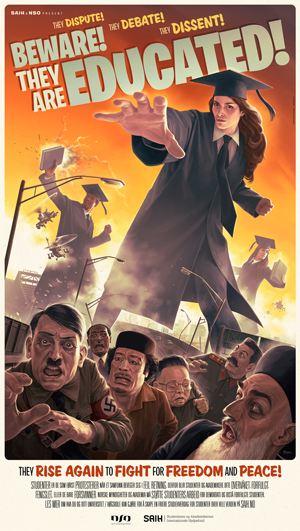 Fast forward to today, and one unsurprisingly finds that the rights students now enjoy have flourished, as they increasingly have been included in the decision making processes that affect them. The explanation for this development is twofold; firstly as students increasingly voiced their demands in such a way that they could not be ignored, politicians had to accommodate their concerns, and secondly education was increasingly seen as a right, and not a privilege. The World Education Forum & UNESCO reaffirmed education as a human right in 2000, and the same year the Millennium Declaration set forth the goal of achieving the right to basic education for all. Developing from a rather vague definition, education was bolstered as a human right, something which helped establish a widened agenda of access to higher education, grounded in international law.
While this development is rather clear in Norway as well as in other liberal democracies, authoritarian states rather than accommodating their citizens’ opinions actively silence them through extralegal measures of fear, extortion and confinement. In addition access to higher education is reserved for the privileged few who can afford to pay for it. These two structural factors maintain a society wherein not only physical control over the masses, but additionally control of the very ideas that shape society represents every reason why academic freedom is so highly valued in liberal democracies.
As the need for an educated workforce is growing, so is the access in higher education widened, even in authoritarian regimes. That means that even when the government might be opposed to offer education opportunities to those who might critique the status-quo, these groups will end up being represented within higher education institutions. Who constitutes these groups? In most cases it would be students from lower socio-economic stratums in society, indigenous groups and other national minorities, members of the LGBT community as well as religious minorities.
Students have been at the forefront of most recent uprisings. In Iran they were among the first to contest the election results of the 2009 presidential elections. In Egypt in the early days of the Arab Spring students who had studied at American institutions in Egypt were inspired by natural law theories and liberal ideas, which played directly into manifestations in Tahir Square. While the immediate protests gather media attention, and violent responses garner some outcry from governments and international organizations, the repercussions that are felt by the students engaged in these activities are often forgotten. Numerous students have been imprisoned and expelled on bogus charges in countries like Colombia, Chile, Bahrain, Iran, Belarus and Zimbabwe. The list goes on.
One of the problems tied to these expulsions is that the reasons provided by the universities increasingly have been plagiarism. This is an intentional effort by authoritarian regimes to prevent outspoken students from continuing their studies abroad at another university, and provides yet another effort to silence critical voices. So when students who have been expelled for political activism try to continue their studies abroad, they are not only faced with the challenge of adapting to an entirely different system of education, they are also faced with the prospect of never being able to attain a degree, simply because they enacted their inherent human rights.
 With this backdrop the Students at Risk project was launched in September of 2013 by the Norwegian government. The project which initially was developed by SAIH, Students and Academics International Help fund, and supported by the Norwegian Student Organisation was announced by then Norwegian Foreign Minister Espen Barth Eide and Minister of Development Cooperation Heikki Holmås. The pilot project will invite students who have been expelled due to political activism, to finish their studies in Norway. The project is set to launch in Fall 2014, and will invite 20 students who will be able to finish their studies in Norway while receiving a scholarship from the Norwegian government to cover their expenses while studying. The program is not entirely fleshed out yet, but in its current iteration SAIH will help to find eligible candidates using their partner organizations abroad. This means that even if governments have proclaimed plagiarism as a reason for expulsion, it will no longer stop these students from continuing their studies, as the real reasons for the expulsion will be accounted for.
The students at risk project will help to embrace education as a human right, not in word only, but through action. The students who seek societal change and who oppose authoritarian governments will have a real alternative if they are met with negative sanctions. And perhaps most importantly, the project solidifies that the rights students in Norway and other liberal democracies have achieved are not exclusive, but belong to the entirety of the human population. The right to education is universal, and this is another step in the right direction to realizing those ideals.
By Matias Olsen,
Leader of the International Committee of the Norwegian Student Organisation NSO, Board member of the Center for Sami Studies and a student of Political Science at the University of Tromsø.