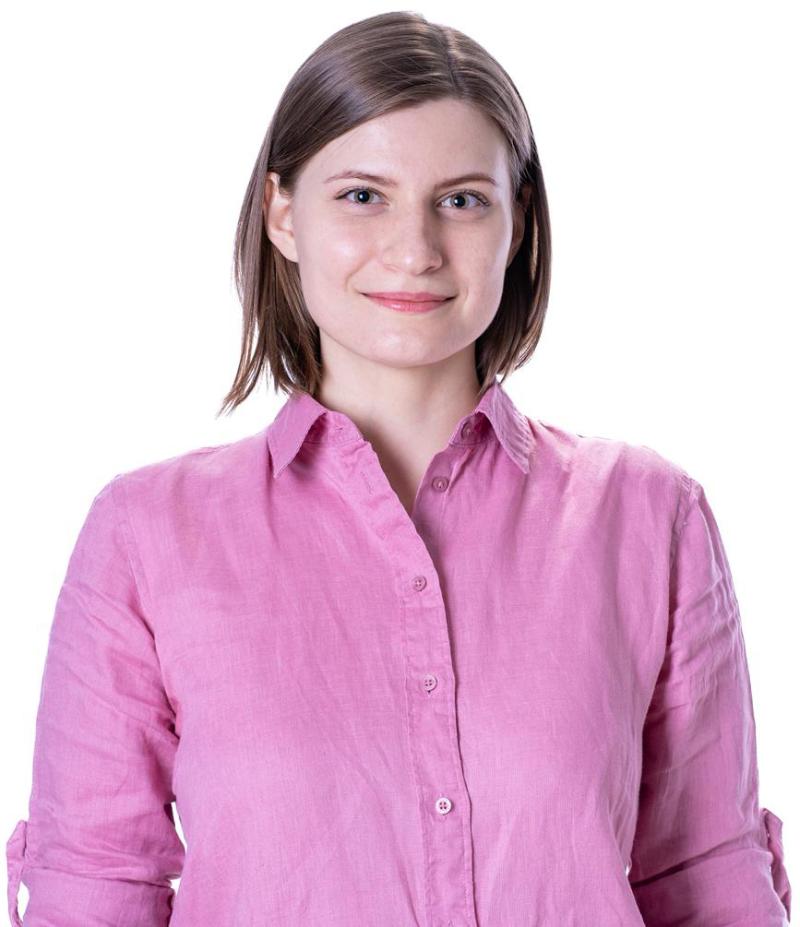
Master of Science Olga Paikina will hold the Trial Lecture and Thesis Defense for the PhD degree in Science on Wednesday, September 23, 2026.
Trial Lecture
The Trial Lecture will take place 10:15 - 11:15.
The title of the Trial Lecture is:
« Northern Lights: How the solar wind interacts with Earth’s magnetic field and atmosphere »
Thesis Defense
The Thesis Defense will take place 12:15 - 15:00.
The title of the thesis is:
« Intermittent fluctuations and particle transport at the boundary of fusion plasma »
Abstract
Fluctuation-driven transport of particles and heat in the boundary of magnetically confined plasmas is dominated by the radial motion of filamentary structures that are hotter and denser than the surrounding plasma. This transport leads to elevated particle densities and temperatures at the first wall, causing material erosion and release of impurities into the confined plasma. A predictive description of the filament dynamics and the resulting fluctuation statistics is therefore vital for estimating plasma-wall interactions in future fusion reactors.
Single-point measurements in the scrape-off layer display universal statistical properties, well described by a stochastic model representing the fluctuations as a super-position of uncorrelated, radially propagating pulses. This thesis combines an extension of this framework with a comprehensive analysis of measurements on Alcator C-Mod. The framework is extended to include pulse velocities correlated with the pulse amplitudes, as suggested by blob velocity scaling theory, resulting in pulse stagnation and radially increasing intermittency of the fluctuations.
With increasing core plasma density, the average profiles broaden and blob motion comes to dominate the entire scrape-off layer. The measured profile e-folding lengths agree with the stochastic model prediction, implying that average profiles can be estimated from measured filament parameters. The measured blob sizes and velocities reveal a gradual transition from the sheath-connected to the resistive velocity scaling regime as the empirical discharge density limit is approached. Electron temperature fluctuations become increasingly intermittent at high densities, and conductive contributions to the heat flux become comparable to the convective contribution, so that heat loads cannot be estimated from density fluctuations alone. Based on these results, first predictions of blob sizes and velocities are made for the SPARC tokamak.
Supervisory Committee
- Professor Odd Erik Garcia, Department of Physics and Technology, UiT (Main Supervisor)
- Associate professor Audun Theodorsen, Department of Physics and Technology, UiT
- Dr. Gregor Decristoforo, Head of Research Software Engineering (RSE), UiT
Evaluation Committee
- 1st Opponent: Dr. Anne E. White, School of Engineering Distinguished Professor of Engineering, Department of Nuclear Science and Engineering, Massachusetts Institute of Technology (MIT), USA.
- 2nd Opponent: Professor Fulvio Militello, Executive Director of Plasma Science and Fusion Operations, UK Atomic Energy Authority (UKAEA) Culham Science Centre, Great Britain.
- Internal member and leader of the committee: Professor Krishna Agarwal, Department of Physics and Technology, UiT, Norway
Streaming
The Trial Lecture and Thesis Defense will be streamed via Panopto:
Trial Lecture (10:15 - 11:15)
Watch the Trial Lecture
Thesis Defense (12:15 - 15:00)
Watch the Thesis Defense
Thesis
The thesis is available in Munin:
Når: 23.09.26 kl 10.15–15.00
Hvor:
Store Auditorium B302, Realfagbygget
Sted: Digitalt, Tromsø
Målgruppe: Ansatte, Studenter, Gjester / eksterne, Inviterte, Enhet
E-post: daniels.sliks@uit.no