Nordic applicants: 4009
EU / EEA / Switzerland applicants: 7101
Non-EU/EAA applicants: 2010
About the study
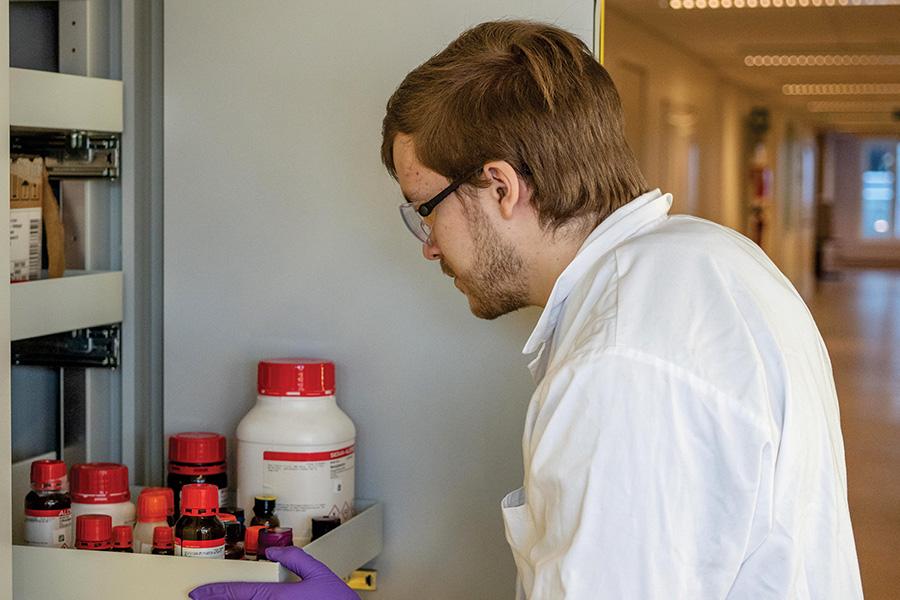
Do you like the idea of creating completely new compounds and materials with unique properties? Perhaps a new and improved anticancer agent, solar panel component, a safe food colorant or the latest medical imaging pharmaceutical to be used at the hospital? With specialization in Chemical Synthesis and Spectroscopy, you will achieve thorough skills and knowledge in how to make new organic and inorganic molecules and materials, and how to determine their structures and properties using spectroscopic and analytical techniques.
This discipline is one of three specializations included in the Master's Degree Progam in Molecular Sciences.
What will you learn?
After completion of the programme, the candidate:
Knowledge
- has an overview of discipline-relevant scientific approaches to analyse and understand molecular properties and processes
- has thorough knowledge of theory and methods used in molecular sciences
- has advanced insight into international research and development within her or his discipline
- has acquired advanced knowledge and understanding needed to contribute to innovation and discovery within her or his discipline
Skills
- can independently use and analyse various sources of information to structure and formulate scientific arguments
- can independently produce and analyze data, products and results employing discipline-relevant scientific methods, instrumentation, and software
- can critically analyze and evaluate the quality of data and results
- can conduct scientific work and document results in accordance with applicable standards and norm for research ethics
- can carry out independent limited research under supervision
- can plan and carry out chemical syntheses of organic or inorganic molecules
- can analyse synthetic and natural substances with advanced chromatographic, spectroscopic and/or crystallographic methods
General competence
- can critically read, cite, analyse and understand scientific literature
- can independently communicate scientific information clearly and precisely, bothwritten and oral forms
- can independently analyse and judge the reliability of information obtained from different sources and has a sound critical attitude towards knowledge from all sources
- can independently conduct research activities and communicate the research questions and results in both written and oral forms
- can carry out knowledge-based evaluations of general problems in science and communicate this to the public
- can accomplish research projects under guidance, e.g. under a PhD program in molecular sciences, chemistry or related areas
- can apply the obtained knowledge to independently solve new problems in natural sciences and to contribute to research and innovation
Programme structure
Programme structure
Se emnene du tar hvert semester (M-KJEMI)Studiesteder du kan utveksle til
Admission requirements
You can be qualified if you have a Bachelor degree in:
- Chemistry
- Molecular sciences*
- Pharmacy*
*with a minimum of 30 ECTS in chemistry.
Bachelor's degrees within other related areas may be considered on an individual basis.
For complete information regarding admission requirements, see Admission requirements for Master in Molecular Sciences.
Har du spørsmål?




You might also be interested in


Følg @uitstudent på Instagram eller TikTok for å få et enda bedre innblikk i hvordan det er å studere på UiT. Her viser studentene fram sin studiehverdag, deler tips og nyttig informasjon, og du kan stille spørsmål om alt du måtte lure på.
Sjekk også @uitnorgesarktiske på Instagram eller TikTok for info om studier, jobbmuligheter og forskning.
